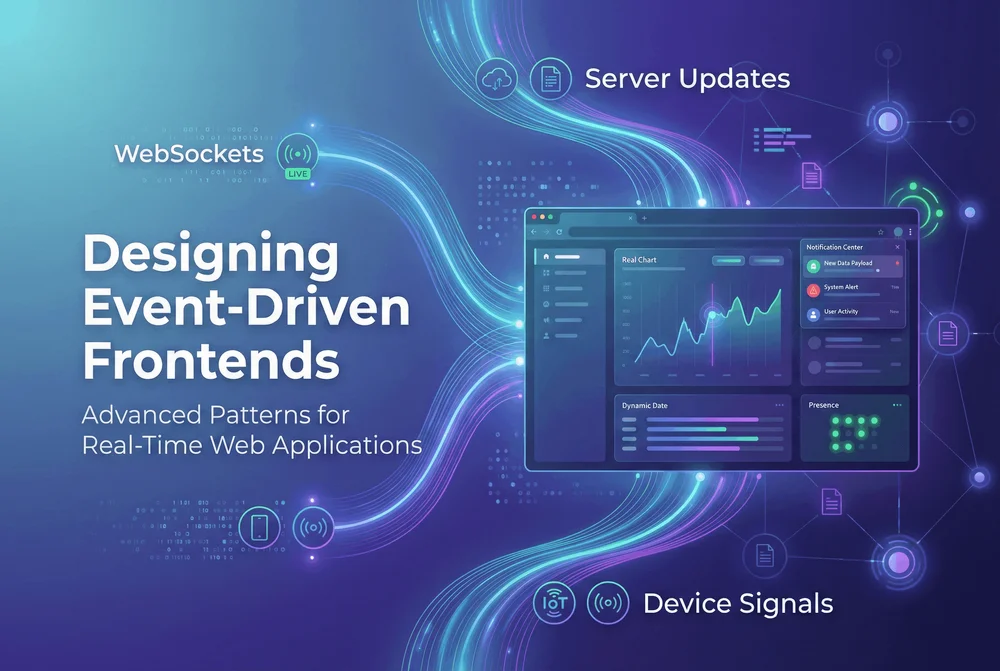
Designing Event-Driven Frontends: Advanced Patterns for Real-Time Web Applications
- Premium Results
- Publish articles on SitePoint
- Daily curated jobs
- Learning Paths
- Discounts to dev tools
7 Day Free Trial. Cancel Anytime.
User interfaces no longer respond only to clicks and page loads. Modern applications respond to continuous streams of server, network, and device events, similar to patterns seen in real-time tracking in logistics, where location and status updates continuously reshape UI state. Event-driven architecture routes events through handlers that isolate state updates from rendering.
It queues and sequences asynchronous updates before state mutation and rendering. Traditional request-response models struggle under real-time concurrency and partial failures. Event-driven patterns improve resilience by isolating change propagation from rendering logic. The frontend coordinates local state changes with server and peer updates across active sessions.
The Shift from Request-Response to Real-Time UIs
Request-response models assume a stable state between interactions, which fails under continuous server-driven change. Modern interfaces consume event streams, not snapshots. State changes from server events, background sync, and updates triggered by other connected users. The frontend shifts from passive rendering toward distributed state coordination.
When Your Frontend Needs Event-Driven Patterns (Use Cases)
Event-driven patterns apply when concurrent users update shared records that must stay synchronized across sessions. Collaborative editors, live dashboards, and presence indicators require immediate propagation. Offline recovery and reconnect flows benefit from decoupled event handling.
Frontend Constraints in Real-Time Applications
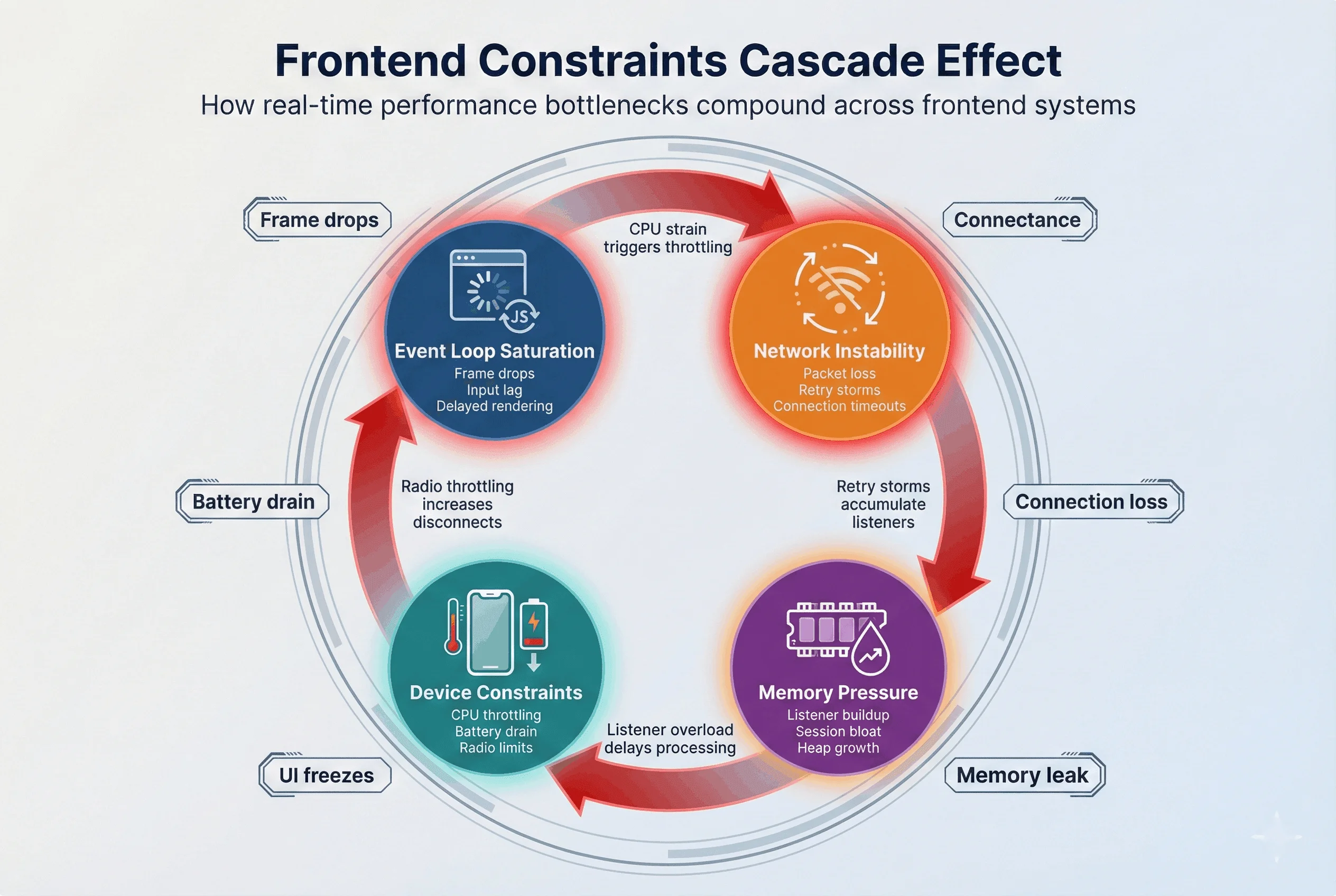
Browser memory limits, CPU scheduling, and network latency directly constrain sustained real-time responsiveness. High event volume delays rendering cycles and increases input lag under limited CPU availability. Packet loss and retry delays cause events to arrive late, duplicated, or out of sequence. Limited mobile CPU, memory, and radio power restrict sustained event processing and persistent connections.
Event Loop Saturation
High-frequency events compete with rendering and input handling. Poor scheduling can delay frames and degrade interaction predictability.
Network Instability
Latency variance and disconnections disrupt event ordering and delivery. Frontends must tolerate gaps without corrupting state or blocking interaction.
Memory Pressure
Unreleased listeners accumulate across months and reconnects. Leaks silently degrade performance and destabilize long-lived sessions.
Device Constraints
Mobile CPUs and radios throttle aggressively. Event volume and retry behavior must respect power, thermal, and background execution limits.
Real-Time Communication Protocols for the Frontend
Real-time communication protocols define how frontends receive, transmit, and recover event streams. Protocol choice determines connection persistence, retry behavior, and how quickly updates reach the UI.
Full-Duplex Streams with WebSockets
WebSockets support continuous bidirectional messaging over a single connection. They fit interactive systems with frequent client and server updates. Connection lifecycle, backpressure, and heartbeat handling define reliability under load.
One-Way Streaming with Server-Sent Events
SSE streams server updates over standard HTTP connections. Server-Sent Events suit broadcast updates where clients only receive server-generated changes. Unidirectional flow simplifies state handling and failure recovery.
Modern Transport with HTTP/2 and HTTP/3
HTTP/2 and HTTP/3 reduce connection overhead and prevent packet loss from blocking unrelated streams.
| Category | HTTP/2 | HTTP/3 |
|---|---|---|
| Transport | TCP-based multiplexed streams | QUIC over UDP |
| Latency Behavior | Reduced head-of-line blocking per connection | Eliminates TCP head-of-line blocking |
| Failure Recovery | Connection stalls under packet loss | Faster recovery under packet loss |
| Operational Fit | Broad support, simpler deployment | Improved mobile and unstable networks |
Protocol Trade-offs in Practice
Each protocol differs in reconnection behavior, message direction, and server resource consumption.
| Category | WebSockets | SSE | Long Polling |
|---|---|---|---|
| Directionality | Bidirectional | Server to client | Client initiated |
| Latency | Lowest | Moderate | Highest |
| Reconnection Handling | Application-managed | Browser-managed | Request-based |
| Operational Complexity | High | Moderate | Low |
| Best Use Case | Interactive real-time systems | Broadcast updates | Constrained environments |
UI State Management in Event-Driven Frontends
UI state management in event-driven frontends governs how asynchronous events reshape local state without breaking consistency or responsiveness.
Reconciling Server Events with Local State
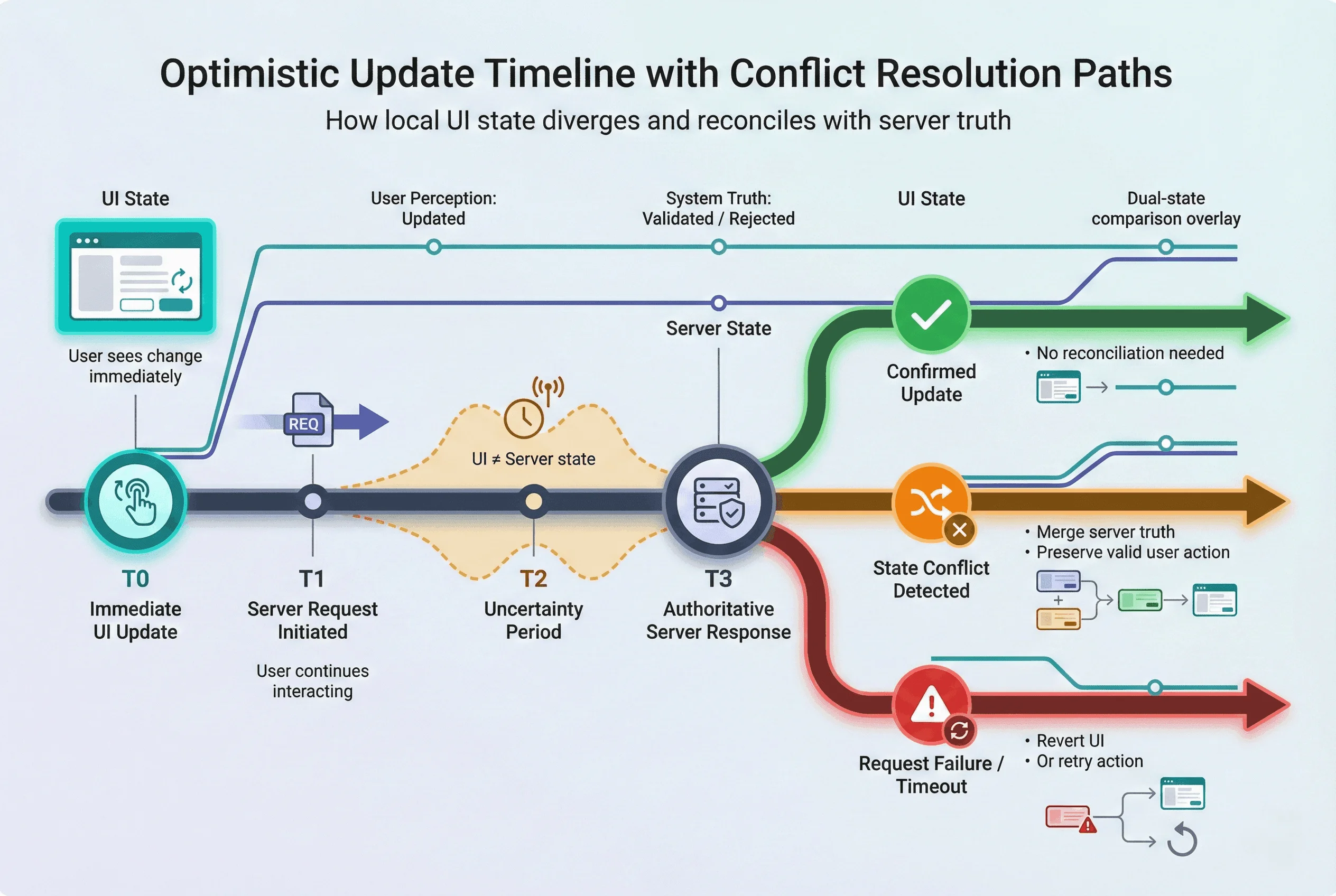
Server events arrive asynchronously and can invalidate optimistic assumptions made by the UI. State models must merge server updates without resetting active inputs or rerendering unchanged UI elements.
Optimistic Updates and Conflict Resolution
Optimistic updates improve perceived responsiveness by applying changes before server confirmation. Conflicts emerge when authoritative events contradict local assumptions. Conflict resolution must keep the user's last valid action while discarding outdated or rejected server updates.
Event Sourcing on the Frontend
Event sourcing rebuilds UI state from ordered event streams instead of mutable snapshots. Stored event logs allow rebuilding the state after crashes and inspecting exact change sequences. Event ordering and compaction determine feasibility.
State Management Options for Real-Time Apps
Redux with middleware supports explicit event ingestion, WebSocket integration, and controlled side effects under concurrent updates.
Zustand, Jotai, or MobX enable fine-grained reactivity with lower coordination overhead across rapidly changing states.
Real-time database clients like Firebase, Supabase, and Convex abstract synchronization while constraining conflict resolution and state ownership models.
Design Patterns for Event-Driven Frontends
Design patterns for event-driven frontends structure how events flow, mutate state, and propagate effects under concurrency and failure. These patterns separate event producers and consumers to prevent unintended cross-component state updates.
Pub/Sub with Custom Event Emitters
Decouples producers from consumers through an event bus. Vanilla JavaScript emitters reduce dependency weight but require strict lifecycle cleanup.
Observer Pattern for Component Reactivity
React effects depend on explicit dependency control and cleanup discipline. Vue watchers and RxJS observables propagate change automatically, but increase subscription complexity.
Command Pattern for Undoable Actions
Commands encapsulate intent and reversal logic. This pattern supports retries, undo stacks, and deterministic recovery. Each action becomes auditable, replayable, and isolated from UI timing.
CQRS in the Browser
| Aspect | Read Model | Write Model |
|---|---|---|
| Purpose | Serve UI queries and derived views | Handle commands and state mutations |
| Data Shape | Optimized for rendering and access | Optimized for validation and intent |
| Change Trigger | Updated from processed events | Emits events after command execution |
| Separation Goal | Never mutates state | Never serves UI reads |
| Trade-off | Duplication and sync cost | Coordination and complexity overhead |
Handling Race Conditions and Event Ordering
Out-of-order events require timestamps or sequence identifiers to restore causal consistency during delayed or retried delivery.
Debouncing and throttling regulate input bursts, preventing event storms from starving rendering and network pipelines.
Idempotency keys block duplicate processing during retries, reconnects, or optimistic resubmission.
Handling Concurrent Edits in Collaborative UIs (Operational Transformation vs. CRDTs)
| Approach | Conflict Model | Consistency Strategy | Operational Cost |
|---|---|---|---|
| Operational Transformation | Rebases concurrent operations | Centralized ordering | High coordination overhead |
| CRDTs | Merges concurrent state changes | Mathematical convergence | Higher memory and payload cost |
Production Challenges and Real-World Trade-offs
Production challenges emerge when real-time systems meet scale, failure, and adversarial conditions in cloud-native DevOps infrastructure. These trade-offs expose limits hidden during local development and controlled testing.
Scaling WebSocket Connections: Load Balancing and Sticky Sessions
WebSockets stress connection affinity and horizontal scaling. Sticky sessions simplify state locality but reduce failover flexibility. Stateless fan-out prevents single-node failure but requires external systems to coordinate event distribution. Connection strategy determines how many concurrent users a system can support without performance degradation.
Graceful Degradation When Real-Time Fails
Fall back to polling when persistent connections collapse under network or proxy constraints. Freeze optimistic updates during disconnects to prevent irreversible divergence. Degrade features selectively instead of disabling entire interfaces.
Monitoring and Debugging Event-Driven Frontends
Browser DevTools expose WebSocket frames, timing gaps, and malformed payloads. Event stream logging enables replay, causality inspection, and post-incident reconstruction.
Security Concerns: Authentication, Authorization, and Rate Limiting
| Control | Risk Addressed | Enforcement Point |
|---|---|---|
| Authentication | Unauthorized connection access | Connection handshake |
| Authorization | Cross-tenant data exposure | Event routing layer |
| Rate Limiting | Resource exhaustion and abuse | Gateway and client guards |
Practical Implementation Examples
Step 1: Real-time collaborative editor synchronizes edits through ordered events, resolves conflicts, and rebuilds the state after reconnects.
Step 2: Live stock dashboards stream updates and batch rendering while separating ingestion pipelines from visual state. This pattern commonly appears in environments powered by smart warehouse technologies, where device events constantly drive interface change.
Step 3: The chat application treats typing indicators and read receipts as transient signals, not a persisted state.
Step 4: Multiplayer game state combines server authority with client prediction, reconciliation, and rollback.
What Would Change If You Redesigned This Today?
Edge functions and regional WebSocket servers reduce latency by executing closer to users. Regional execution reduces cross-region latency but requires synchronization between distributed state stores. GraphQL subscriptions consolidate reads and events behind a single schema. GraphQL subscriptions unify queries and updates but require server control over event rate and queueing.
Real-time backend platforms abstract scaling, transport, and presence. They accelerate delivery but constrain ownership, conflict resolution, and long-term architectural control. HTTP/3 and QUIC improve resilience under packet loss and mobility. HTTP/3 improves delivery under packet loss, but monitoring support remains inconsistent across browsers and proxies.
Best Practices and Anti-Patterns
Best practices and anti-patterns define how event-driven frontends remain resilient under scale, failure, and continuous change. The table contrasts architectural choices that stabilize event flow against decisions that amplify operational risk.
| Practice | Practice Type | Architectural Impact | Failure Risk |
|---|---|---|---|
| Centralized Event Management | Do | Predictable event flow | State divergence |
| Error Boundaries | Do | Localized fault isolation | UI-wide failure |
| Retry Logic | Do | Controlled recovery | Silent event loss |
| Overusing WebSockets | Don't | Scaling pressure | Resource exhaustion |
| Ignoring Lifecycle Events | Don't | Orphaned listeners | Memory leaks |
| Tight Coupling | Don't | Reduced composability | Change amplification |
Key Takeaway
- Event-driven frontends treat the browser as a distributed system participant, not a passive rendering surface.
- Real-time reliability depends more on state isolation, ordering, and recovery than transport choice.
- Browser constraints, not backend throughput, set the upper bound for real-time UX stability.
- Architectural patterns matter most when failures, retries, and concurrency collide in production.
- Simplicity at the protocol layer often shifts complexity into state coordination and lifecycle control.