MaxClaw by MiniMax: Everything You Need to Know About the New Always-On AI Agent Update
- Premium Results
- Publish articles on SitePoint
- Daily curated jobs
- Learning Paths
- Discounts to dev tools
7 Day Free Trial. Cancel Anytime.
AI agent development has shifted from "can we build it?" to "how fast can we deploy it?" MiniMax, the Chinese AI lab behind products including Hailuo AI, is making a direct play for that deployment gap with MaxClaw, an announced AI agent platform that bundles a foundation model, an agent framework described as open-source, and integrations with Telegram, WhatsApp, Slack, and Discord.
Table of Contents
- What Is MaxClaw? MiniMax's Announced Always-On AI Agent Platform
- How MaxClaw Works: Architecture and Key Components
- Supported Channels: Telegram, WhatsApp, Slack, and Discord
- MaxClaw vs. DIY Agent Stacks: How It Compares
- Limitations and Open Questions
- Who Should Pay Attention to MaxClaw
- The Bigger Picture: What MaxClaw Signals for AI Agents
- Key Takeaways
What Is MaxClaw? MiniMax's Announced Always-On AI Agent Platform
MiniMax at a Glance: Who's Behind It
MiniMax is a Beijing-based AI lab that has built a distinct position in generative AI through its work on video generation and multimodal models. The company operates Hailuo AI, a video generation platform, among other products, and its ambitions span foundation models, agent infrastructure, and developer tooling. MiniMax entering the agent platform space matters because the company has shown a willingness to compete at the model layer, not just the application layer, giving it vertical integration options that pure-play framework providers lack.
The MaxClaw Announcement: What MiniMax Says It's Shipping
MaxClaw is not simply a model release or an API update. MiniMax describes it as a product umbrella encompassing three distinct components shipping together: OpenClaw, an agent framework described as open-source; the MiniMax agent hosting and runtime framework, which provides managed infrastructure for persistent agents; and the foundation model powering the agents (MiniMax initially called the model "M2.5," though this designation has not been independently confirmed against MiniMax's public model documentation. Verify the current model name at api.minimax.chat).
The naming is worth clarifying upfront. MaxClaw refers to the full product platform. OpenClaw is the open-source component within it, handling agent definition, memory, and tool orchestration. The MiniMax runtime is the managed hosting layer. The foundation model powers reasoning and tool use. These three pieces work as an integrated stack, but OpenClaw's described open-source nature would give it a life outside the MiniMax ecosystem as well.
How MaxClaw Works: Architecture and Key Components
MaxClaw's described architecture stacks three layers: the foundation model communicates with the OpenClaw framework layer, which in turn runs on the MiniMax managed runtime. The runtime connects to channel connectors (Telegram, WhatsApp, Slack, Discord), which interface with end users. MiniMax has not published an official architecture diagram at time of writing; consult MiniMax documentation for authoritative component relationships.
The Foundation Model: What Powers the Agents
At the core of MaxClaw sits MiniMax's foundation model, designed for the specific demands of persistent agent workloads. According to MiniMax, the model supports a large context window (exact size not published), multimodal input processing (specific supported modalities such as text, image, audio, or video have not been confirmed), and reliable tool-use and function-calling capabilities. No failure-rate data has been published. All three properties matter for agents that need to maintain state across long conversations, invoke external services, and reason over diverse input types.
This model would compete with models commonly used in agent stacks: GPT-4o from OpenAI, Claude from Anthropic, and Gemini from Google. No one has published independent benchmark comparisons at time of publication. The described differentiator is not raw benchmark supremacy but optimization for agent workflows. A model optimized for persistent agent operation needs to handle tool-calling reliably at high frequency, manage context efficiently across extended interactions, and keep latency low enough for real-time messaging (typically sub-2-second response times for a conversational UX to feel responsive; MiniMax has not published latency targets). General-purpose models can do all of this, but they are not always tuned to prioritize these characteristics, and they introduce separate API billing that adds up quickly in always-on scenarios.
The described differentiator is not raw benchmark supremacy but optimization for agent workflows.
OpenClaw: The Described Open-Source Agent Framework
OpenClaw handles agent definition, memory management, tool orchestration, and conversation state. It provides the structural scaffolding that determines how an agent reasons, what tools it can invoke, how it retains context across sessions, and how it manages multi-turn conversations.
If MiniMax open-sources OpenClaw as described (license type unconfirmed at publication; no repository URL has been independently verified; search github.com for "OpenClaw" and verify the license file before commercial use), the implications would be real. It would lower the barrier to entry, allow community contributions, and provide transparency into how agent logic is structured. It also positions OpenClaw as a potential alternative to established frameworks like LangChain and AutoGen. The difference is integration depth: LangChain is model-agnostic by design; AutoGen focuses on multi-agent conversation orchestration and is model-flexible but not infrastructure-neutral. OpenClaw is purpose-built to work with the MiniMax runtime and foundation model without additional glue code or configuration. That tight coupling is both its strength (reduced configuration, smoother interoperability) and its limitation (reduced flexibility).
The MiniMax Agent Runtime: Managed Hosting and Deployment
The managed runtime is where MaxClaw diverges most sharply from the typical DIY agent stack. MiniMax says it handles server infrastructure, scaling, and availability without requiring the developer to provision cloud instances, manage containers, or configure load balancers. No specific SLA percentages or uptime guarantees have been published.
The "always-on" designation is meaningful. For the purposes of this article, "always-on" refers to a persistent agent process that maintains state and accepts inbound messages without cold-start initialization delays (cold starts in serverless agent setups commonly add 2 to 10 seconds of latency). Traditional API-based agent interactions are stateless: a request comes in, the model responds, and the connection closes. Persistent agent processes, by contrast, maintain running state, can initiate actions proactively, and handle asynchronous conversations without those startup penalties. MiniMax has not publicly documented the persistence mechanism (persistent containerized processes, managed WebSocket connections, or another approach). For messaging platforms where users expect near-instant responses at any hour, this distinction translates directly into user experience quality. The runtime abstracts away the complexity of keeping these processes alive, monitored, and responsive, which is precisely the infrastructure burden that frustrates teams building agents on top of raw model APIs and self-managed hosting.
Note: Messages sent to MaxClaw-powered agents are processed by MiniMax's infrastructure. Review MiniMax's data processing agreement and ensure your privacy policy and platform terms permit this routing before deployment.
Supported Channels: Telegram, WhatsApp, Slack, and Discord
Multi-Channel Integration
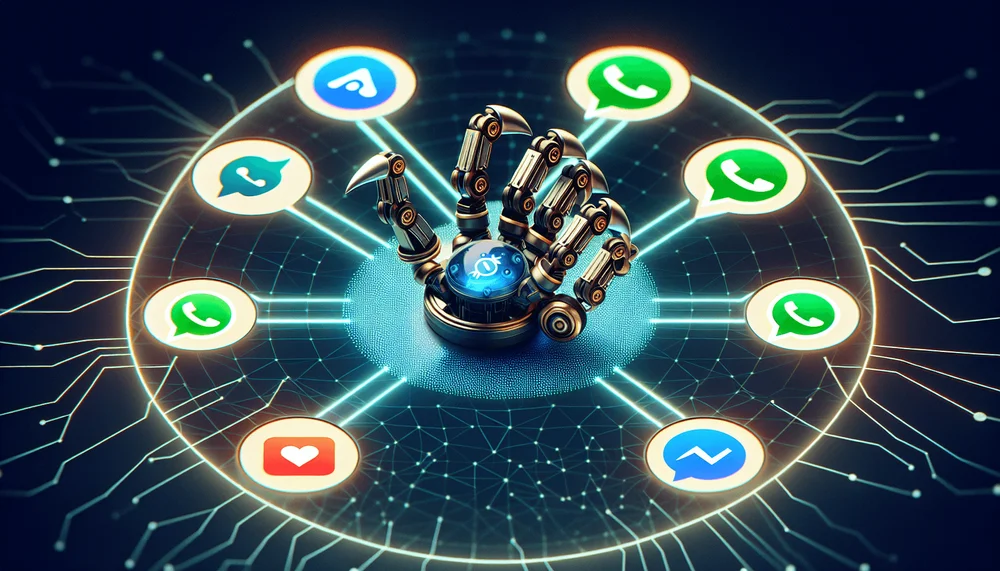
According to MiniMax, MaxClaw provides built-in connectors for Telegram, WhatsApp (requires a Meta-approved WhatsApp Business API account with business verification and per-message fees; this is not a free or instant setup), Slack, and Discord. The platform handles authentication, message routing, and platform-specific formatting required by each service's API. Developers would not need to build and maintain separate bot integrations per channel, manage webhook endpoints, or handle the idiosyncrasies of each platform's message delivery model.
Instead of writing distinct integration code for each messaging service, developers define agent logic once within OpenClaw and deploy across channels. This does not mean all channels behave identically; per-channel nuances in message formatting, attachment handling, and interaction patterns will persist. But maintaining four separate bot codebases would collapse into configuration-level decisions rather than engineering projects.
Platform-specific requirements not covered in MaxClaw's described feature set: WhatsApp Business API requires Meta business verification (which can take days to weeks), has per-conversation pricing (template messages vs. session messages), and has strict policies against certain automation patterns. Slack requires App creation with appropriate OAuth scopes. Discord requires a Bot Token with proper gateway intents. Telegram requires a BotFather token. These prerequisites apply regardless of the agent platform used.
What This Means for Teams and Workflows
The practical use cases for always-on agents across these channels are substantial: customer support bots that operate around the clock on WhatsApp, internal team assistants in Slack that answer questions and trigger workflows at any time, community management agents in Discord that moderate and respond without human intervention, and notification agents in Telegram that push alerts and handle follow-up conversations.
The always-on characteristic matters most for messaging platforms because user expectations on these channels differ fundamentally from email or web forms. Users on Slack or WhatsApp expect responses within seconds, not minutes. Asynchronous conversations may span hours or days, requiring the agent to retain context reliably. A stateless, cold-start architecture introduces latency and context loss that directly degrades these interactions.
The always-on characteristic matters most for messaging platforms because user expectations on these channels differ fundamentally from email or web forms.
Cost note: Always-on persistent agents incur continuous compute costs. Unlike request-based pricing where you pay per API call, persistent agent processes may generate ongoing hosting charges even during idle periods. Confirm the billing model with MiniMax before deploying production workloads.
MaxClaw vs. DIY Agent Stacks: How It Compares
This table compares the described trade-offs between adopting MaxClaw and building a custom agent stack using frameworks like LangChain or AutoGen with self-managed cloud infrastructure. Several MaxClaw data points are based on vendor descriptions and have not been independently verified.
| Criteria | MaxClaw (MiniMax) | DIY Stack (LangChain / AutoGen + Cloud) |
|---|---|---|
| Setup Time | Unverified (vendor describes rapid setup; no independent benchmark available at publication) | Days to weeks (custom code + infra) |
| Hosting / Infrastructure | Described as fully managed by MiniMax | Self-managed (AWS, GCP, VPS, etc.) |
| Foundation Model | MiniMax foundation model (included) | BYO model (OpenAI, Anthropic, etc.) |
| Agent Framework | OpenClaw (integrated) | LangChain, AutoGen, CrewAI, etc. |
| Channel Integrations | Described as built-in: Telegram, WhatsApp, Slack, Discord | Custom per channel (bot APIs, webhooks) |
| Ongoing Maintenance | Described as platform-managed updates | Developer-managed updates, patching |
| Cost Model | Pricing not publicly documented at time of publication (see Limitations section) | Separate: hosting + model API + monitoring |
| Customization / Flexibility | Moderate (within OpenClaw framework) | High (full code control) |
| Vendor Lock-In Risk | Higher (MiniMax ecosystem) | Lower (swap components freely) |
| Open-Source Component | OpenClaw (core framework described as open-source; runtime is managed/closed) | Fully open-source stacks available |
Where MaxClaw May Win
The most immediate described advantage is deployment speed. Teams without dedicated infrastructure engineers could go from agent concept to live deployment across multiple messaging channels in less time than with a DIY approach, though MiniMax has not quantified the difference. The integrated billing model would eliminate the cognitive overhead of managing separate invoices for hosting, model API usage, and monitoring tools. For small teams or solo developers who want to validate an agent concept before committing to custom infrastructure, collapsing container management, load balancer configuration, and uptime monitoring into a managed service removes real friction.
Where DIY Stacks Still Make Sense
Full control over model selection remains the strongest argument for building custom. Organizations that need to switch between GPT-4o, Claude, and open-weight models based on cost, capability, or regulatory requirements will find MaxClaw's single-model dependency constraining.
Complex custom orchestration patterns that go beyond what OpenClaw supports, such as deeply nested multi-agent workflows or domain-specific reasoning chains, are better served by the unrestricted flexibility of frameworks like LangChain or AutoGen. And organizations with existing infrastructure investments, established CI/CD pipelines, and compliance requirements around specific cloud regions or providers have less to gain from a managed platform and more to lose from single-vendor dependency.
Limitations and Open Questions
What We Don't Know Yet
Several critical details remain unconfirmed. MiniMax has not published benchmark performance of its foundation model against leading models on agent-specific tasks such as tool-calling accuracy, multi-step reasoning, and long-context retention. Pricing tiers and rate limits at scale remain unclear, which matters enormously for teams evaluating production viability. Check back for updates on customization depth within OpenClaw for advanced use cases beyond standard patterns as the framework matures.
Compliance Warning: MiniMax is headquartered in China, and data processed through its infrastructure may be subject to Chinese data laws (e.g., the Personal Information Protection Law, PIPL). Until MiniMax publishes a verified data processing agreement with explicit data residency commitments, organizations subject to GDPR, HIPAA, SOC 2, or financial regulations must not use MaxClaw for production workloads involving personal data. Data residency policies, privacy guarantees, and enterprise compliance posture are deployment blockers, not minor caveats, for regulated industries and organizations with data sovereignty requirements.
Potential Risks to Consider
Vendor lock-in to the MiniMax ecosystem is the most obvious risk. If MiniMax changes pricing, deprecates features, or experiences reliability issues, teams deeply integrated into MaxClaw have limited exit paths. The platform has no published incident history, uptime metrics, or customer case studies, making its production reliability an open question for any team considering it for customer-facing applications. We could not independently verify OpenClaw's community size or third-party integration ecosystem at time of publication, meaning fewer tutorials, integrations, and battle-tested patterns may be available compared to the established communities around LangChain and AutoGen.
Who Should Pay Attention to MaxClaw
Recommended Use Cases
If your team spends more time on Docker configs and webhook debugging than on prompt engineering and agent logic, MaxClaw's managed runtime is aimed directly at you. Solo developers and small teams who want persistent AI agents running on messaging platforms without managing servers or container orchestration are the clearest potential beneficiaries.
Businesses that already rely heavily on Telegram, WhatsApp, Slack, or Discord as primary communication channels and want to add agent capabilities without building custom bot infrastructure should evaluate MaxClaw once availability and documentation are confirmed. Teams currently drowning in the complexity of deploying and maintaining DIY agent stacks may find the managed runtime appealing, particularly if infrastructure work consistently crowds out time spent on the agent itself.
Who Can Probably Wait
Enterprises with strict data sovereignty or compliance needs should hold off until MiniMax publishes detailed data residency, privacy, and data processing documentation. Teams deeply invested in existing agent frameworks with production workloads running smoothly have little reason to migrate until MaxClaw demonstrates clear advantages in cost, performance, or capability through published benchmarks and production case studies.
The Bigger Picture: What MaxClaw Signals for AI Agents
MaxClaw represents a broader industry shift from "agent toolkits" to "agent platforms," where the model, framework, hosting, and channel integrations ship as a single product. This mirrors moves by OpenAI with its Assistants API (the architectural parallel for persistent, tool-using agents; CustomGPTs serve a different, conversational wrapper use case), Google with Vertex AI Agents, and Microsoft with Azure AI Agent Service (Copilot Studio targets low-code users and is a distinct product category). MiniMax pairs its platform with an open-source component in OpenClaw, which functions as both a competitive differentiator and a community acquisition strategy.
The trajectory is clear: expect more "one-click agent deployment" products throughout 2025, as the competitive advantage shifts from having the best model to having the most frictionless path from idea to running agent.
The trajectory is clear: expect more "one-click agent deployment" products throughout 2025, as the competitive advantage shifts from having the best model to having the most frictionless path from idea to running agent. MaxClaw is an early and aggressive entry in that race. Whether it gains traction depends on three things MiniMax has not yet delivered: public benchmarks, transparent pricing, and a verified compliance posture. Without those, it stays on the "interesting but undeployable" list.
Key Takeaways
- MaxClaw bundles MiniMax's foundation model, the OpenClaw framework, and managed hosting with messaging channel integrations into a single announced platform. Independent verification of availability and claims is pending.
- Deployment friction could drop for teams targeting Telegram, WhatsApp, Slack, and Discord by eliminating separate hosting, bot integration, and API billing management, though no one has independently benchmarked the improvement.
- DIY stacks retain advantages in model flexibility, deep customization, and avoiding single-vendor dependency, particularly for teams with existing infrastructure.
- Critical unknowns remain around foundation model benchmarks, pricing at scale, data residency, compliance posture, and platform maturity for production workloads. These are deployment blockers, not minor caveats.
- Compliance is a hard gate: organizations subject to GDPR, HIPAA, or financial regulations must not deploy MaxClaw for personal data workloads until MiniMax publishes verified data processing agreements.
- The broader trend points toward bundled agent platforms becoming the default entry point, with open-source components like OpenClaw potentially serving as a differentiator in an increasingly crowded field.
This article is an analysis of publicly described features and positioning. Readers should consult official MiniMax documentation at minimax.io and api.minimax.chat for current technical details, availability, and pricing.